Monday 16th trial week

Today I moved classes to fashion from graphics. I did this because I feel that it will steer me towards the career that I want, which is making my own brand.

In today’s lesson we designed a t-shirt, first of all we had to mark down the design using a pencil and a wooden rule. We also had an instructions sheet to follow which helped me a lot as I had missed the week where everyone else had learned how to design. I then drew up my outline onto the calico and then cut around it with a extra 1 cm seam allowance. I did this so that it wouldn’t be too tight for me when I came to wear it.
Pattern Cutting

The definition of pattern cutting is: Pattern cutting is making a basic pattern, to your specific measurements, that you can adapt to make different styles or trousers, skirts or bodices. Because they are based on your own measurements the fit will be much better than with a commercial pattern that you buy.

This process is extremely important because if you get it wrong or the markings are slightly off you could ruin the entire garment. Now technology is in the picture pattern cutting is even more essential to the industry as more and more items are being sold online as well as in shops.

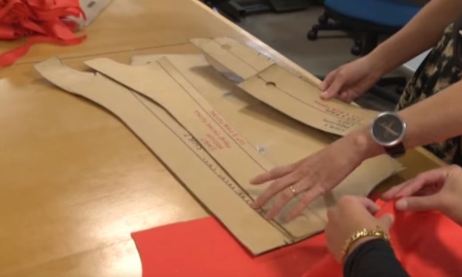
The first process is marking out the garment, this is usually done using a model or manikin to perfectly fit the desired look. Capture 2

Next you have to mark out the measurements on the fabric and then make sure that they’re perfectly drawn.

Capture 3

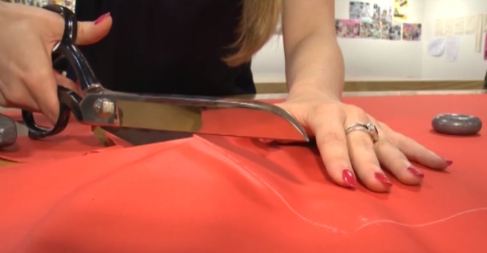
After that you will need to cut along the lines very carefully to make sure you stay in your desired line.

Capture 5

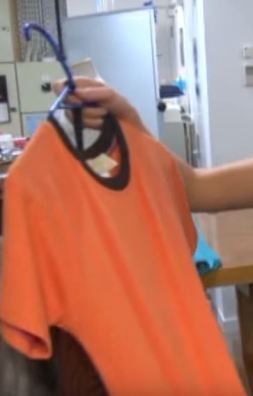
This is the finished design after they sewed it up and added on the collar. Unfortunately the lighting isn’t as good in the final picture therefore making it look a different colour to the previously cut fabric.

Capture 4


Different types of seams

Super imposed seam:

This seam is created by two or more pieces of fabric being sewed together. It is one of the most commonly used seams. The fabric ends in the same direction and it has over 50 different variations.

Image result for super imposed seam

Lapped seam:

This type of seam is created when two or more pieces of fabric coming from opposite directions overlap each other. This seam is very strong.

Image result for lapped seam

Bound seam:

A bound seam is when one piece of fabric surrounds the edge of another piece of fabric. The purpose of bound seam is to finish an edge of the garment. It is sometimes used to decorate the edge. There are 18 different variations of the seam.

Image result for bound seam

Flat seam:

Flat seams are constructed by having two pieces of fabric meet precisely on their edges. Using this seam decreases the seams thickness creating a nicer look.

Image result for Flat seam

Decorative seam:

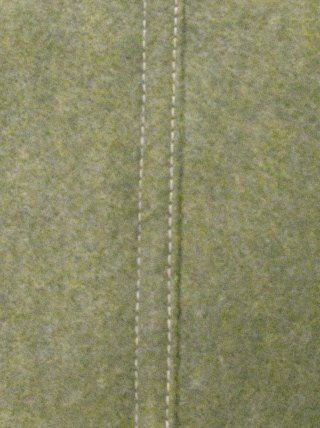
This type of seam is made by making multiple stitch lines in one or more layers of fabric. A multi needle sewing machine is used to create this seam. These seams are only used for decorative purposes.

Image result for decorative seam

Plain seam

In a Plain seam two fabrics are joined together along the seam line by a  line of stitching. It is also sometimes called a single needle Butterfly stitch.

Image result for plain seam

Hairline seam

This is an enclosed seam which is mostly used for collars. The seam isn’t visible from the outside as it gets enclosed creating a more aesthetically pleasing look.

Image result for hairline seam