Shingo Sato is an innovative pattern maker and designer. She is one of the leading figures of a new movement in the fashion industry.
TR cutting is a form of origami pattern cutting which turns into immediate 3D creations.

Shingo Sato is an innovative pattern maker and designer. She is one of the leading figures of a new movement in the fashion industry.
TR cutting is a form of origami pattern cutting which turns into immediate 3D creations.
Subtraction cutting is when a pattern that is cut doesn’t represent a garments outward shape and instead shows off the negative space within the garment. This image shows off a piece of Julia Roberts work.
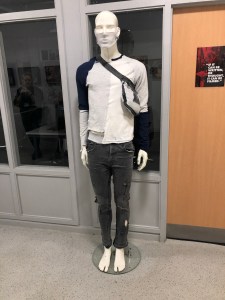
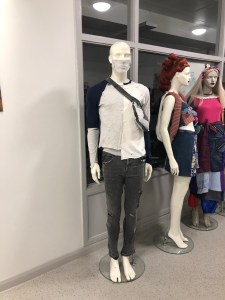
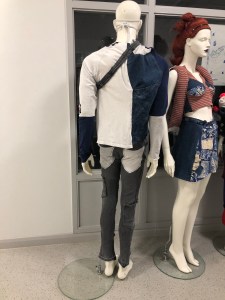
I think that me and Ryan worked as a team extremely well, I personally contributed all of the unpicking of the garments and I helped with the designing of our final piece as well. Our outcome was very successful as it came out exactly as we wanted it to and we had barely any waste left over. Next time I would try and switch up our roles a little bit more so that Ryan would do some unpicking and I would do some sewing. All of our garments work perfectly, our face mask works just like the branded ones on the market and our bag works perfectly as well. We were extremely close to achieving a zero waste outcome, we probably could’ve fitted the extra little bits into our bag but it was already very full and we didn’t want to unzip it again just in case the stuff flew out everywhere. I think that we presented our project very well. Ryan took the lead and explained everything then I went over anything that he had missed.
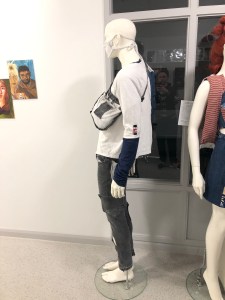
We will show off all the different elements of our outfit including the small details that our peers might have missed.
We will speak about the process of making the upcycled garments and explain how we used each other’s strengths to maximise the amount of work getting done.
We have met the brief as we barely have any waste left over as we used it as filling for our bag. This is our leftover waste from the project.
In my group it was just me and my partner Ryan and therefore we didn’t have as many people as the other groups did. To stop this from putting us behind we focused on each other’s strengths. I was much faster at unpicking than Ryan and he was much faster at pinning and sewing than I was. As soon as I finished unpicking a part of the garment he would sew it onto our final piece and then by the time he’d finished that bit I’d have the next bit ready for him. This turned out to be a very good strategy as we were able to easily finish in the time given with the design that we wanted.
After watching the documentary I now know how bad the conditions are that the locals are forced to live in just because these big companies want to make clothes extremely quickly. They had polluted the air and their water sources just by operating near them.
Stacey also shows just how many gallons of water goes into making just one tee or one pair of jeans. This extra water is used to help get the clothes made quickly and at an affordable price for the consumer.
Zero Waste is a set of principles focused on waste prevention that encourages the redesign of resource life cycles soap that all products are reused.
Their goal is for no trash to be sent to landfills, incinerators or the ocean.
The benefits of zero waste is a cleaner planet and if everyone joins in no trash will be wasted.
Tess Whitfort is an Australian zero waste designer. She owns an upcycling company in Hong Kong called R Collective.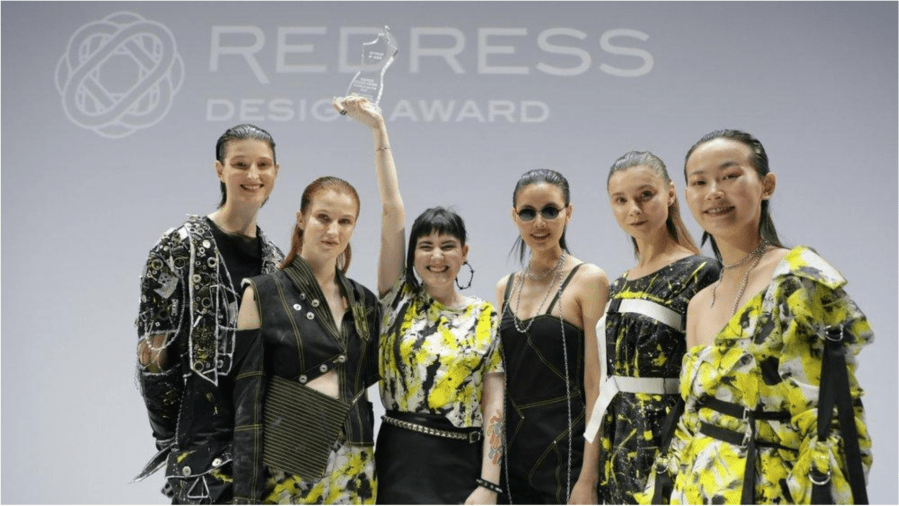 She also won the 2018 Redress design award.
Upcycling is when you reuse discarded objects or materials to relate a product of higher quality or value than the original.
We should upcycle because it reduces the amount of waste that is dumped into landfill and conserves the resources meaning that we don’t have to get new resources.
Make do and mend is to manage with and repair the possessions that one already has rather than buying replacements.
Nicole McLaughlin is very big in the upcycling movement, she has her own website where she sells her own upcycled clothes. 
Unfortunately we both completely forgot to take pictures of our garments before we started to unpick them, by the time we had realised we had already started sewing the different elements together. We also realised that we were meant to take photos of our dismantled garments. The closest thing that we have to this is a picture of me unpicking the seams of each item of clothing. In this image you can see a very messy pile of our different elements.

 Fashion Blog by Max Horner